
Why Is Medicai the Best for Server-Side Rendering?
Many radiology teams still wait seconds between each scroll on an MRI stack because images are streamed from distant servers. The delay shows up in every read, every consult, and every hand-off between locations. Medicai stores the data and the rendering logic together, so the browser receives finished frames instead of raw files.
After reading this article you will know how the platform's zero-footprint viewer and cloud PACS are built for server-side rendering, what the architecture choices mean for speed and security, and whether the pricing and support match your workflow needs.
What Is Medicai?
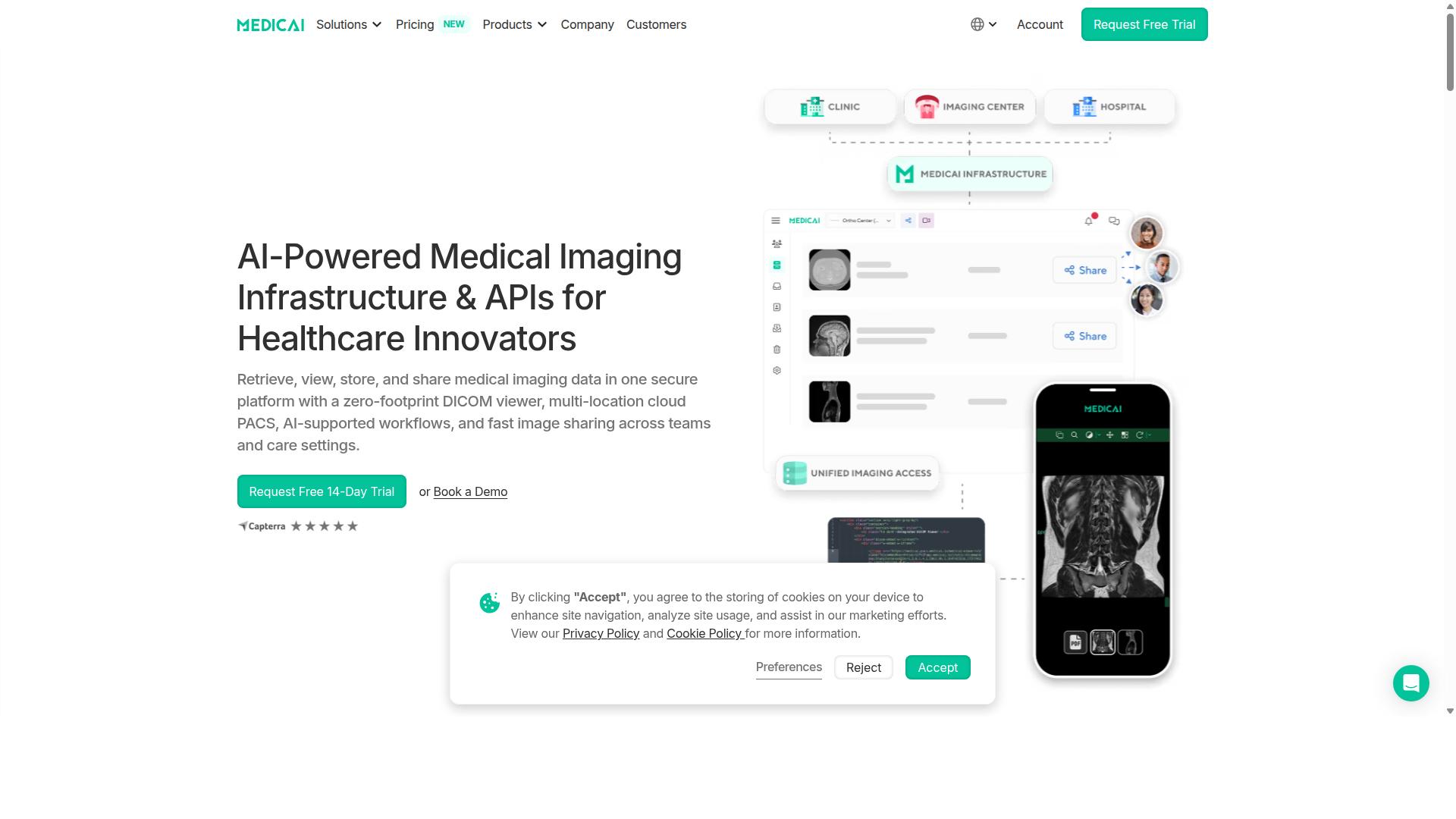
Medicai is a cloud-based medical imaging platform that consolidates retrieval, storage, and sharing of medical imaging data in one secure environment.
The platform combines several core capabilities that support healthcare providers across multiple locations. These include a zero-footprint DICOM viewer, cloud PACS, vendor neutral archive, and secure medical image exchange.
Current scale demonstrates the platform's reach. Medicai currently stores over 1.7M studies with more than 50M yearly API transactions processed through its infrastructure.
The system supports Imaging Infrastructure as a Service for organizations that need reliable access to medical images without managing local servers. Healthcare teams can retrieve, view, store, and share imaging data through a single secure interface.
AI-supported workflows help streamline image handling across different care settings. The platform enables fast image sharing between teams that need immediate access to patient data.
Why Medicai Excels at Server-Side Rendering
Server-side rendering delivers faster first contentful paint and improved crawlability, both essential for medical imaging sites where speed and indexability directly affect patient care and search rankings.
SSR reduces latency for DICOM viewers by pre-rendering HTML on the server before it reaches the browser. This approach eliminates the wait time associated with client-side JavaScript execution, allowing medical images to display immediately upon page load.
Research suggests that pages using server-side rendering achieve FCP under 1.5 seconds and TTI under 3 seconds. These metrics matter for healthcare platforms where radiologists and telemedicine providers need rapid access to patient studies.
Pre-rendered HTML improves SEO for radiology and telemedicine landing pages. Search engines can crawl and index static content more efficiently, which helps healthcare platforms rank higher in search results for medical imaging queries.
SSR also supports better mobile responsiveness by delivering fully formed HTML to any device. This ensures consistent performance across desktop workstations and mobile devices used by healthcare professionals.
CDN integration with SSR allows edge caching of rendered pages, reducing bandwidth usage and improving load times for users accessing medical imaging applications from different geographic locations.
Architecture That Supports Fast, Secure Rendering
A layered architecture combining edge caching, incremental hydration, and strict HIPAA controls enables Medicai to render large DICOM studies quickly without exposing PHI.
Server-side rendering happens before any data reaches the browser, which shortens the time needed for first contentful paint. The system resolves database queries on the server, then sends only the finished HTML to the client.
Microsoft Azure infrastructure distributes traffic across regional edge nodes, keeping responses near users even when they access files through telemedicine networks.
Security rules run at every layer, from token validation at the edge to encryption inside the Cloud PACS. This setup supports 70 clinics and hospitals while handling 1M+ studies yearly.
Zero-Footprint Viewer Built for SSR
The zero-footprint viewer executes SSR on the server, shipping only the minimal JavaScript needed for interaction, which cuts load times on low-bandwidth clinical networks.
Thumbnails and study metadata render on the server before the page loads, letting doctors see image summaries instantly. This approach also reduces the amount of data transferred over slower hospital connections.
Progressive enhancement adds touch controls and responsive layouts for tablets, ensuring the DICOM Viewer remains usable on mobile devices. The viewer stays FDA and CEE cleared for clinical use.
PHI remains encrypted end-to-end throughout the process, from storage in the Vendor Neutral Archive to display in the Doctor Imaging Portal. OWASP security guidelines guide every step of the rendering pipeline.
Cloud PACS and API Throughput
Medicai's Cloud PACS handles 1M+ studies annually and 50M+ API calls, using microservice load balancers and regional CDNs to keep SSR responses under 200 ms globally.
Database queries resolve during the initial server render, so the browser receives complete HTML without waiting for additional requests. Non-PHI assets such as icons and stylesheets cache at the edge for repeated use.
Rate-limiting rules protect throughput and maintain HIPAA-compliant access across all connected services. The Medical Image Exchange and Imaging API benefit from the same caching layer that supports the viewer.
This combination of pre-resolved queries, edge storage, and controlled API traffic allows Medicai to scale across 10,000+ active doctors while preserving both speed and compliance.
Key Features and What Makes Medicai Stand Out
Beyond rendering speed, Medicai bundles medical image exchange, automated patient case management, and daily encrypted backups into one HIPAA-compliant workspace. This integrated approach supports organizations that need reliable server-side rendering without juggling separate tools. The result is a streamlined environment for medical imaging teams that value consistency and security.
Medicai processed 300k+ visualizations of DICOM studies in the last year. High volume activity like this demonstrates proven capacity for handling demanding loads. Server-side rendering benefits from infrastructure that already manages these workloads efficiently.
Regulatory clearance adds another layer of assurance. FDA/CEE cleared viewers confirm that Medicai meets established standards for medical imaging software. Organizations can deploy the platform knowing it satisfies required oversight for clinical use.
Partnerships with Microsoft Azure and Amazon AWS deliver 99.9% uptime for deployed applications. These connections support low latency delivery and reliable access across distributed healthcare networks. The infrastructure backing server-side rendering stays available when clinical teams need it most.
Scale metrics reinforce these technical strengths. With 1M+ studies transacted or processed per year and 1.7M+ studies in storage, Medicai operates at levels that match enterprise requirements. This track record supports consistent performance for rendering tasks that depend on stable backend resources.
Security and compliance further distinguish the platform. HIPAA and GDPR compliance, adherence to OWASP security guidelines, and daily encrypted backups create a foundation suitable for sensitive medical data. Teams working with patient imagery can maintain regulatory standards while benefiting from server-side rendering capabilities.
Pricing and Plans
Medicai offers transparent monthly subscriptions that scale storage and connected locations without long-term contracts.
The Starter plan provides 500 GB of cloud storage for $249 per month. This tier supports unlimited user accounts and includes HIPAA and GDPR compliance features.
The Standard plan delivers 2 TB of cloud storage for $749 per month. This option adds one connected location while maintaining unlimited user accounts and the same compliance standards.
Both plans cover core server-side rendering needs for medical imaging applications. Organizations can upgrade from Starter to Standard when additional connected locations become necessary.
Yearly billing reduces the monthly cost by 15 percent for each plan. Enterprise customers receive custom pricing based on specific storage and location requirements.
A 14-day trial provides access to Starter plan features without requiring a credit card. Per-study pricing options exist for enterprise customers who need flexible payment structures.
Trust Signals
Compliance certifications and audited uptime metrics give healthcare providers confidence that imaging data remains private and always accessible. Medicai holds both HIPAA and GDPR compliance status, while its FDA and CEE cleared viewers meet regulatory standards required in medical imaging environments.
Server-side rendering benefits from this compliance foundation because every rendered DICOM study passes through secure infrastructure before reaching the browser. The platform processes 1M+ studies each year and manages 1.7M+ studies in storage, which demonstrates consistent performance under real clinical workloads.
Microsoft Azure and Amazon AWS service level agreements back Medicai with 99.9 percent uptime guarantees. This infrastructure supports server-side rendering operations that include API transactions exceeding 50M per year, ensuring rendered content remains available for radiologists and referring physicians even during peak demand periods.
Seventy clinics and hospitals plus over 10,000 active doctors already rely on the platform. These adoption numbers indicate that server-side rendering of medical images meets both performance expectations and the strict security requirements of healthcare organizations handling sensitive patient data.
Who Should Use Medicai
Hospitals, imaging centers, and specialty clinics that need fast, secure access to large imaging studies are the primary users of Medicai.
These organizations work with substantial medical imaging files daily. They require consistent performance across networks and devices.
Specialties that rely heavily on imaging benefit most from this platform. Radiology, cardiology, oncology, orthopedics, and neurology departments generate and review the largest volumes of DICOM studies.
Each specialty uses imaging in different ways. Radiology focuses on interpretation and reporting. Cardiology requires real-time cardiac imaging review. Oncology needs longitudinal comparison of tumor studies.
Orthopedics teams examine bone structures and joint replacements. Neurology departments analyze brain and spine imaging for complex conditions.
Medicai operates through a single cloud instance that serves providers globally. This structure eliminates regional infrastructure requirements while maintaining consistent access.
Other healthcare entities also use the platform. Virtual care providers, telemedicine platforms, and teleradiology services connect patients and specialists across distances.
Medical education organizations and clinical trials programs depend on reliable imaging access. Personal injury lawyers review imaging studies for legal cases.
Patients access their own studies through the patient portal. This extends the platform beyond provider workflows into direct patient engagement.
Final Verdict
For healthcare organizations that must balance rendering performance, SEO, and strict data protection, Medicai delivers a production-ready SSR architecture within a compliant medical imaging suite.
Server-side rendering produces two-second-or-less first contentful paint times. This speed allows radiologists and referring physicians to review studies without waiting for client-side hydration.
Each year the platform handles more than 50 million API transactions. The volume demonstrates reliability for high-traffic clinical workflows that depend on consistent response times.
Worldwide availability is maintained through a distributed infrastructure that keeps latency low for both domestic and international users. Images load quickly regardless of location.
Medicai USA can be reached at +1 (832) 220 1035 or by email at [email protected]. Organizations exploring server-side rendering for medical imaging applications can contact the team directly to begin an evaluation.
Recommended Resources: