
Ambra Health vs Medicai for Vendor-Neutral Archives
Hospitals often run two separate vendor-neutral archives after a merger because the original systems refuse to share patient data without extra fees.
This article shows you the exact storage, security, and integration differences between Ambra Health and Medicai so you can pick one archive instead of paying for both.
Quick Verdict: Ambra Health vs Medicai for Vendor-Neutral Archives
Medicai processes 1M+ studies per year and stores 1.7M+ studies on its HIPAA/GDPR-compliant, FDA/CEE-cleared cloud PACS. The platform delivers a zero-footprint viewer with 50M+ yearly API transactions, making it a strong contender for vendor-neutral archive needs. Ambra Health offers a general VNA solution that covers the basics of medical imaging storage and access.
Medicai supports 300k+ visualizations of DICOM studies in the last year across 70 clinics and hospitals. The platform also serves 10,000+ active doctors who access studies through a scalable cloud infrastructure. Ambra Health provides standard VNA capabilities but lacks the same level of documented API throughput and study processing volume.
Both platforms address HIPAA compliance, yet Medicai emphasizes OWASP security guidelines and GDPR adherence as core requirements. Research suggests that high API transaction volumes indicate stronger interoperability features for healthcare organizations. Ambra Health maintains a solid presence in the VNA market without sharing specific transaction metrics.
Organizations seeking a vendor-neutral archive should evaluate their current study volume and integration requirements. Medicai's scale of 2M+ imaging studies uploaded demonstrates proven capacity for enterprise imaging environments. The platform's Microsoft Azure partnership further supports reliability for multi-site access scenarios.
At a glance: how Medicai compares to Ambra Health, Medicai for Vendor-Neutral Archives on the features that matter most.
| Feature | Medicai | Ambra Health | Medicai for Vendor-Neutral Archives |
|---|---|---|---|
| Vendor-Neutral Archives | ✓ | ✓ | — |
What Is Medicai?
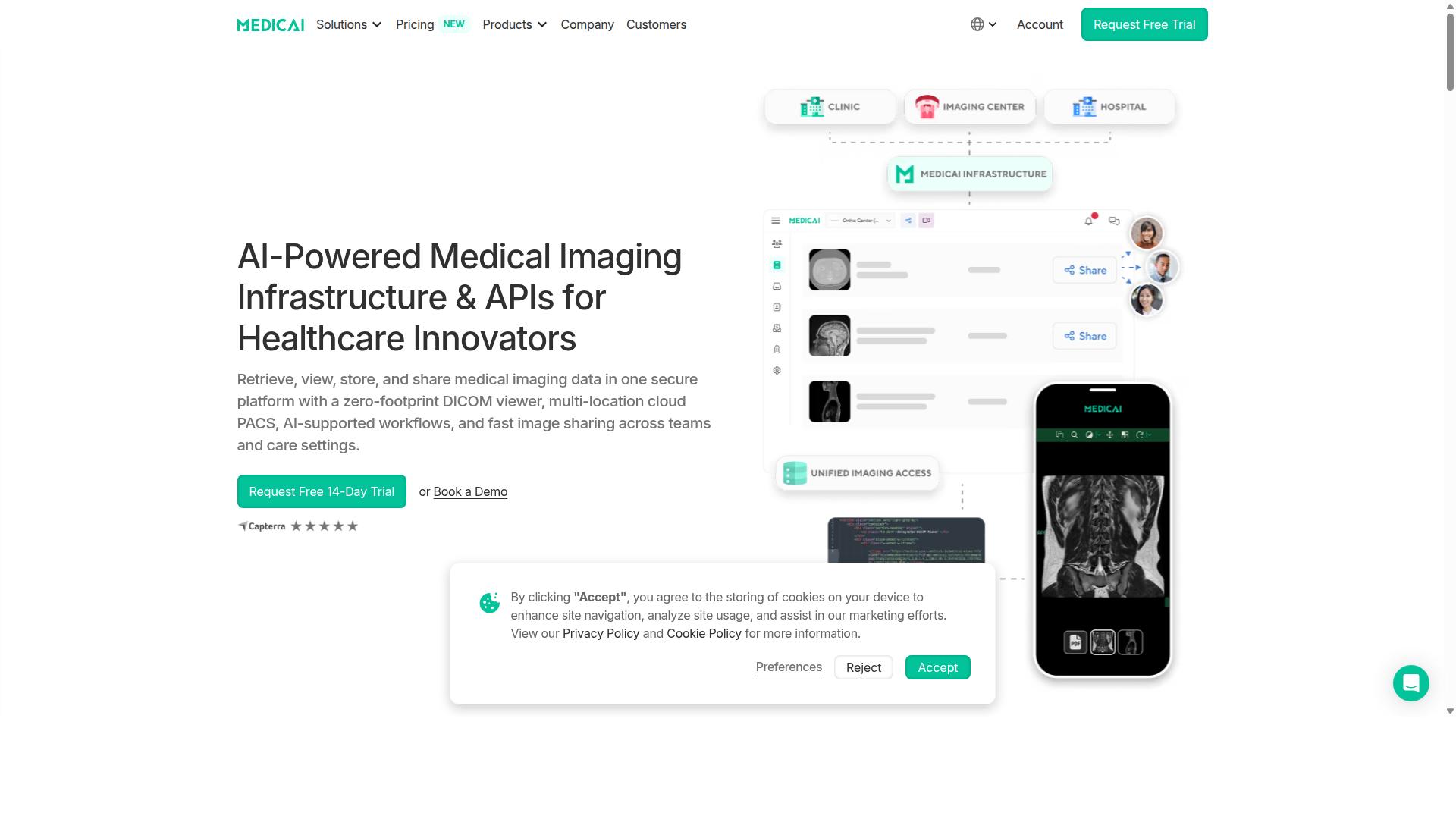
Medicai is a cloud-based medical imaging platform that lets providers retrieve, view, store, and share imaging data through a zero-footprint DICOM viewer. This single secure platform replaces multiple disconnected systems that often complicate radiology workflows and delay care decisions. Providers gain unified access across care settings without maintaining separate local infrastructure.
The platform supports four core capabilities. Connect and Retrieve pulls studies from existing PACS and modalities into one location. Store and Manage keeps imaging data organized with built-in encryption and audit trails. Access and Visualize delivers browser-based viewing for radiologists and referring physicians. Integrate and Automate links these functions with HL7 and FHIR connections that maintain existing workflows.
Medicai provides Imaging Infrastructure as a Service for healthcare organizations that need scalable storage and fast image exchange. The zero-footprint viewer eliminates workstation installations and supports mobile access across departments. Multi-location cloud PACS capabilities allow teams to coordinate studies without physical media transfers or manual routing.
AI-supported workflows help prioritize urgent cases and reduce repetitive tasks for imaging teams. The platform focuses on interoperability by connecting data silos that commonly exist between hospitals and outpatient centers. This approach addresses the vendor-neutral archive requirements that many health systems face during consolidation projects.
What Is Ambra Health?
Ambra Health provides a vendor-neutral archive solution that consolidates imaging studies from multiple sites into a centralized, cloud-accessible repository. This approach targets organizations seeking to reduce reliance on disparate PACS systems. Facilities often pursue this model to improve interoperability across different departments and locations.
The platform supports standard DICOM protocols and enables image exchange between facilities without requiring local infrastructure at every site. Many healthcare systems adopt such solutions when expanding through mergers or acquisitions, where legacy systems must continue operating during transition periods.
Archive consolidation typically involves migrating historical studies while maintaining access for referring physicians. This process requires careful attention to data security and retention policies to meet regulatory requirements. Cloud-based VNAs generally offer scalability benefits compared to on-premises storage, though implementation timelines vary depending on data volumes and existing infrastructure complexity.
What Is Medicai for Vendor-Neutral Archives?

Medicai's Vendor Neutral Archive module stores imaging studies in a modality-agnostic cloud repository that supports HL7/FHIR study routing and de-identification.
The VNA component sits within the STORE & MANAGE product pillar, which also includes Cloud PACS, Medical Image Exchange, Patient Case Management, and Backup and Disaster Recovery services.
This positioning allows the archive to exchange data directly with the CONNECT & RETRIEVE tools, such as the Medical Imaging Uploader and DICOM Gateway, creating a continuous flow from acquisition to long-term storage.
Retention policy controls are handled through the same management layer, giving administrators the ability to set study lifecycles without leaving the platform.
Disaster-recovery backups are provided as a native extension of the archive itself, ensuring that copies remain synchronized with the primary repository and can be restored quickly when needed.
Interoperability is further strengthened by the adjacent ACCESS, VISUALIZE, COLLABORATE pillar, which includes the DICOM Viewer, Doctor Imaging Portal, and Patient Imaging Portal, allowing users to retrieve studies stored in the VNA without additional middleware.
Because the archive accepts data from any modality and routes studies via HL7 and FHIR, organizations can consolidate multiple legacy PACS systems into a single, standards-based repository while maintaining access for downstream applications.
Features Compared
The three feature categories below directly affect radiology workflow efficiency, patient-portal access, and long-term archive costs.
Each area influences how quickly studies move between sites, how securely patient data travels, and how predictable the total cost of ownership becomes over time.
Looking at storage limits, security controls, and integration depth reveals clear differences between the two platforms.
Storage and Scalability
Starter tier provides 500 GB and Standard tier 2 TB, with optional expansion while maintaining 99.99 % uptime via Azure and AWS infrastructure.
Ambra Health describes broad scalability without publishing exact storage tiers, leaving buyers to request custom quotes for each growth stage.
Medicai's published tiers span Starter, Standard, and Enterprise plans. The Enterprise level offers custom cloud storage plus support for multiple connected locations and external sites.
This tiered structure lets practices match monthly spend to actual volume. The one-time DICOM Gateway fee of $1,000 per location remains the only hardware-related cost.
Monthly billing starts at $249 for Starter and $749 for Standard, with yearly plans delivering 15 percent savings. Enterprise customers can negotiate per-study pricing when volume justifies it.
Security and Compliance
Medicai encrypts data at rest and in transit, maintains HIPAA/GDPR compliance, and produces immutable audit trails for every study access.
Ambra Health states general security commitments, yet public materials do not detail encryption standards or audit granularity.
Medicai also follows OWASP security guidelines and offers FDA/CEE cleared viewers. These clearances matter for institutions that must document regulatory compliance during vendor audits.
Immutable audit trails simplify breach investigations because every study view carries a permanent timestamp and user identifier.
Both platforms store data in cloud environments, but Medicai's explicit encryption and compliance stack reduces the documentation burden for hospital IT teams.
Integration and Accessibility
RESTful API endpoints and 50M+ yearly transactions enable seamless modality worklist, prefetching, and patient-portal integrations across 300k+ recent DICOM visualizations.
Ambra Health mentions interoperability in general terms without releasing transaction volumes or API limits.
Medicai's 1M+ studies processed yearly demonstrate real-world throughput under these same APIs. The same endpoints support HL7 and FHIR message exchange for order and report routing.
Zero-footprint viewers let referring physicians open studies on any device without installing software. 10,000+ active doctors already rely on this access model.
These integration capabilities reduce manual steps in multi-site workflows and shorten the time between image acquisition and specialist review.
Pricing Compared
Medicai charges $249/month for Starter (500 GB, unlimited users) and $749/month for Standard (2 TB, one connected location). These clear monthly rates make it easy to forecast costs when evaluating vendor-neutral archive solutions.
Ambra Health does not publish fixed pricing tiers. Their approach typically involves custom quotes that depend on storage volume, user count, and the number of connected sites. This model can make initial budget planning more difficult for radiology departments.
Yearly billing with Medicai provides additional savings. The Starter plan drops to $209 per month and Standard to $639 per month when paid annually, both delivering a 15 percent discount compared to monthly rates.
The DICOM Gateway setup fee is $1,000 one-time per location. This single payment covers installation and configuration for each new site added to the vendor-neutral archive.
Organizations can test features through a 14-day free trial of the Starter plan without providing payment details. This allows teams to assess cloud storage performance and user management capabilities before committing to any expense.
Enterprise customers have access to per-study pricing options when their volume exceeds standard tiers. This flexibility supports hospitals and imaging centers with variable study loads across multiple locations.
Who Should Choose Medicai
Hospitals, imaging centers, and specialty groups (orthopedics, neurology, oncology, radiology, cardiology) that need scalable cloud storage and multi-site access benefit most from Medicai.
These organizations often face growing imaging volumes that strain legacy systems. Medicai has processed over 1M studies annually and maintains more than 1.7M stored studies, offering a proven foundation for high-throughput environments.
Providers seeking vendor-neutral archive solutions gain from a platform built for enterprise imaging. The system supports DICOM workflows and integrates with existing PACS environments without requiring complete system replacement.
Multi-site healthcare networks particularly benefit from centralized access capabilities. Research suggests that organizations managing distributed imaging locations experience improved workflow efficiency when moving to cloud-based vendor-neutral archives.
Specialty practices like oncology and cardiology frequently require seamless image exchange across referring physician networks. Medicai's architecture accommodates these patterns while maintaining HIPAA compliance standards.
Virtual care providers and teleradiology services also align well with this platform's capabilities. The cloud storage model supports rapid image routing and prefetching needed for remote diagnostic workflows.
Medical education organizations and clinical trial coordinators represent additional segments that benefit from scalable, accessible archives. These users often need flexible data sharing without compromising patient privacy requirements.
Who Should Choose Ambra Health
Organizations prioritizing broad archive consolidation across many legacy PACS vendors may consider Ambra Health's VNA-centric approach.
This method helps facilities that manage multiple imaging systems and need a single location for long-term storage. Archive consolidation reduces the risk of data silos and streamlines access across different departments.
Healthcare providers often face challenges when legacy PACS systems cannot communicate with newer platforms. A vendor-neutral archive supports the exchange of DICOM studies and maintains compatibility with existing workflows.
Ambra Health focuses on image exchange and cloud storage services that can support multi-site access. Facilities with distributed locations may find this useful when transferring studies between clinics and hospitals.
Some organizations also require compliance features such as encryption and audit trails to meet regulatory standards. These functions help maintain data security during storage and transmission.
Scalability remains another consideration for growing practices. A VNA can accommodate increasing volumes of medical imaging data without requiring frequent hardware upgrades.
Teams evaluating options should review interoperability capabilities with HL7 and FHIR standards. These connections allow smoother integration with electronic health records and other clinical systems.
Disaster recovery and backup policies also influence the decision. Facilities need reliable retention strategies to protect patient information over extended periods.
Who Should Choose Medicai for Vendor-Neutral Archives
Health systems needing long-term retention, anonymization workflows, and seamless HL7/FHIR study routing should evaluate Medicai's VNA offering. The platform combines cloud storage with integrated tools for compliance and collaboration. Organizations that coordinate care across multiple sites often find these capabilities align with their infrastructure requirements.
Academic medical centers and research institutions benefit from built-in de-identification features that support data sharing for studies. The Vendor Neutral Archive handles retention policies automatically while maintaining audit trails. These institutions value the ability to extract and anonymize imaging data without disrupting existing workflows.
Multi-location health networks gain from disaster recovery capabilities that protect imaging assets across geographic regions. The system supports study routing through established HL7 and FHIR standards. Consolidated archives reduce duplication while preserving access for clinicians at every location.
Specialty clinics that rely on external referrals appreciate the image exchange and patient portal functions. Referring physicians can upload and retrieve studies through familiar interfaces. The platform integrates with existing PACS environments through standard DICOM protocols.
Research programs conducting multi-site trials find value in the structured reporting and collaboration tools. Tumor board support features facilitate case review among distributed specialists. The VNA maintains data integrity while enabling secure access for approved participants.
Final Verdict
Medicai's combination of 1M+ yearly studies processed, 300k+ recent visualizations, and 50M+ API transactions positions it as a scalable, API-first VNA alternative.
Organizations evaluating vendor-neutral archives often need reliable medical imaging storage without vendor lock-in. Medicai delivers this through its API-first design and established compliance framework.
Ambra Health users seeking alternatives may encounter limitations around integration flexibility and real-time access speed. Medicai addresses these concerns with its RESTful services and zero-footprint viewer capabilities.
The platform maintains HIPAA compliance while supporting enterprise imaging workflows across multiple sites. Its cloud storage infrastructure enables multi-site access without additional hardware investments.
Organizations can consolidate existing archives through data migration tools that preserve DICOM metadata and HL7 connections. This approach reduces complexity during system transitions.
Medicai USA, 7901 4th St N, STE 300, St. Petersburg, FL 33702, +1 (832) 220 1035 or [email protected] provides support for radiology departments evaluating VNA options.
Recommended Resources: